
Every retail AI vision project that has failed in production was working before it failed. The cameras were installed. The models were detecting objects. The dashboard was displaying data. And then the store manager stopped looking at the dashboard because the alerts were arriving too late to act on, or the data was not connected to the systems where decisions were actually made, or the staff who were supposed to respond to AI alerts had no clear protocol for doing so. The technology worked. The integration did not. Understanding why integration fails in retail AI vision is more useful than understanding how the technology works, because the technology is the easier part.
Why integration is harder than the technology
Retail AI vision integration fails most commonly for one of three structural reasons that technology vendors consistently underemphasize and retailers consistently underestimate.
The first is data format incompatibility. AI vision systems produce outputs in formats and at resolutions that legacy retail operational systems were not designed to receive. A shelf monitoring system that identifies an out-of-stock condition produces an alert containing a camera ID, a shelf zone coordinate, a timestamp, and a product classification. A warehouse management system expects a SKU, a store location code, a replenishment trigger, and a priority level. The translation between these two data models is not automatic. It requires explicit integration work, and in a retailer running a WMS from one vendor, a POS system from another, and an AI vision platform from a third, that translation layer must be built and maintained as a custom integration.
The second is alert routing without workflow design. AI vision systems generate alerts at volumes and with specificity that create a new class of operational task: responding to AI-generated intelligence. Retailers that deploy AI vision without designing the workflows for responding to its outputs produce a new source of noise rather than a new source of intelligence. A shelf monitoring system that sends 200 alerts per store per day to a general store manager inbox has not solved the out-of-stock problem. It has added an alert management problem. The workflow design question, specifying who receives which alert, with what priority, connected to what action protocol, is a prerequisite to any AI vision deployment that will deliver operational value.
The third is the absence of ground-truth feedback. AI vision models require ongoing calibration against real-world outcomes to maintain their accuracy. A checkout behavior model that flags certain movement patterns as suspicious must receive feedback on whether those flags led to actual incidents or were false positives, so the model can be adjusted. Without systematic feedback loops from operational outcomes to model parameters, AI vision systems drift from their validated performance as store conditions, product assortments, and staff behaviors change. The integration of feedback mechanisms into deployment architecture is rarely prioritized in initial project scopes and is the most common reason for performance degradation in second and third year of deployments.
The integration architecture that works
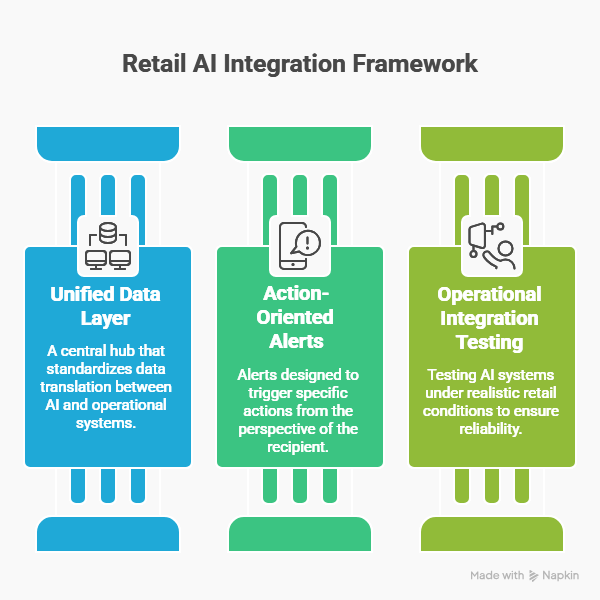
The retail AI vision integrations that deliver sustained operational value share a common architectural pattern, regardless of the specific technology components involved.
The first element is a unified data layer sitting between the AI vision platform and the operational systems it must feed. Rather than building point-to-point integrations between each AI vision output type and each downstream system, a unified data layer standardizes the translation logic in a single, maintainable place. This middleware approach is more expensive upfront but substantially reduces the total cost of integration maintenance as either the AI vision platform or the downstream systems evolve. The approach mirrors the integration architecture patterns that proved themselves in enterprise digital transformation programs and that are described in the broader context of AI governance and enterprise architecture.
The second element is action-oriented alert design. Each alert generated by the AI vision system should be designed from the perspective of the person receiving it and the action it should trigger, not from the perspective of what the model detected. An alert stating “Shelf zone 14-B, gap detected in category: soft drinks, estimated 40% facing loss, replenishment trigger sent to WMS, staff notification: zone 14-B restocking required within 30 minutes” produces a different operational response than an alert stating “Object detection confidence 0.87, bounding box coordinates [x1,y1,x2,y2], timestamp 14:23:07.” Both contain the same underlying detection. Only one is designed to produce action.
The third element is integration testing under operational conditions. AI vision systems tested in controlled conditions often perform differently when deployed in the variable lighting, crowding, and product arrangement conditions of actual retail environments. Integration testing must simulate the operational edge cases that the technology will encounter: peak trading conditions, promotional layouts that differ from standard planograms, staff activities that generate false positive detections, and the network and compute load conditions of high-activity periods. The integrations that survive production do not do so because they worked in testing. They survive because they were tested against conditions that resemble production.
The POS integration: the connection most projects get wrong
The point-of-sale system integration is the AI vision connection with the most direct path to measured business value, and the one most commonly scoped inadequately. Connecting AI vision data to POS transaction data enables analyses that neither system can produce alone: correlating customer flow patterns with purchase conversion rates, identifying the relationship between shelf availability and transaction basket size, measuring the impact of promotional display placement on category sales.
This correlation capability is the intelligence that moves retail AI vision from operational tool to strategic asset, and accessing it requires POS integration that most AI vision platforms do not provide natively. The integration work involves reconciling the temporal alignment between continuous AI vision data streams and discrete POS transaction events, managing the personal data implications of correlating movement data with transaction data, and building the analytics infrastructure that surfaces actionable insight from the combined data.
Retailers that have built this integration, including Kroger, Ahold Delhaize, and several major European grocery chains, report that the POS-correlated analytics produce insight quality that neither system provides independently. The investment required is real. The strategic value produced is commensurate with it.
Workforce systems integration: the undervalued connection
The workforce management integration receives less attention than POS and WMS connections but delivers immediate operational value in environments where labor is a significant cost variable. AI vision systems that can predict customer flow patterns with sufficient accuracy enable workforce scheduling systems to staff stores in advance of demand rather than in reaction to it.
A customer flow prediction model trained on historical AI vision data can generate store traffic forecasts with enough accuracy to inform shift scheduling decisions made 48 to 72 hours in advance. The labor cost savings from better-matched staffing levels are measurable and in high-labor-cost markets represent one of the fastest-payback use cases for AI vision investment. Kronos, now part of UKG, and Deputy are among the workforce management platforms that have built or are building AI vision integration capabilities for this purpose.
The integration is not primarily technical. Workforce scheduling systems are well-designed for receiving demand forecast data. The challenge is the organizational change required to shift scheduling decisions from supervisor intuition to data-driven forecasting: the training, the process change, and the trust-building in AI-generated forecasts that characterizes any successful operational AI deployment.
Privacy by design: the integration constraint that must be a starting point
Retail AI vision integration projects in markets covered by GDPR, CCPA, or comparable privacy regulation must treat privacy compliance not as a constraint applied to a completed integration but as an architectural requirement shaping the integration design. The distinction is practical and significant.
An integration designed from the start with privacy principles will route raw video to on-premises processing, extract and transmit only derived non-personal metadata to downstream systems, implement data retention policies at the point of collection rather than as a post-processing cleanup, and separate individual-level behavioral data from aggregate analytics data in ways that allow the latter without requiring the former. An integration to which privacy requirements are applied after design produces a more expensive, less reliable, and often less compliant solution.
The specific EU AI Act provisions relevant to retail AI vision deployments, particularly around biometric data processing and automated individual profiling, are detailed in EU ai act implementation: what companies must do next. The privacy-by-design approach is not a regulatory burden. It is the architecture that reduces long-term compliance cost and makes the integration more defensible when regulatory scrutiny arrives.
Retail AI vision integration is where the value of the technology is either realized or lost. The systems that generate the documented ROI cases are not the most technologically sophisticated deployments. They are the deployments where the technology was connected to the operational systems and workflows that act on its intelligence, with the workflow design done before deployment rather than after.
For the technology stack behind the integrations described here, see Retail ai vision technology: what’s powering smart stores. For the business case that justifies integration investment, read Is computer vision worth It? retail ROI explained and Retail ai analytics: turning cameras into business insights.
The question every retail AI vision project team should answer before signing the technology contract: If the system works exactly as specified, who receives each alert, what do they do with it, and what operational system records that they did it?