
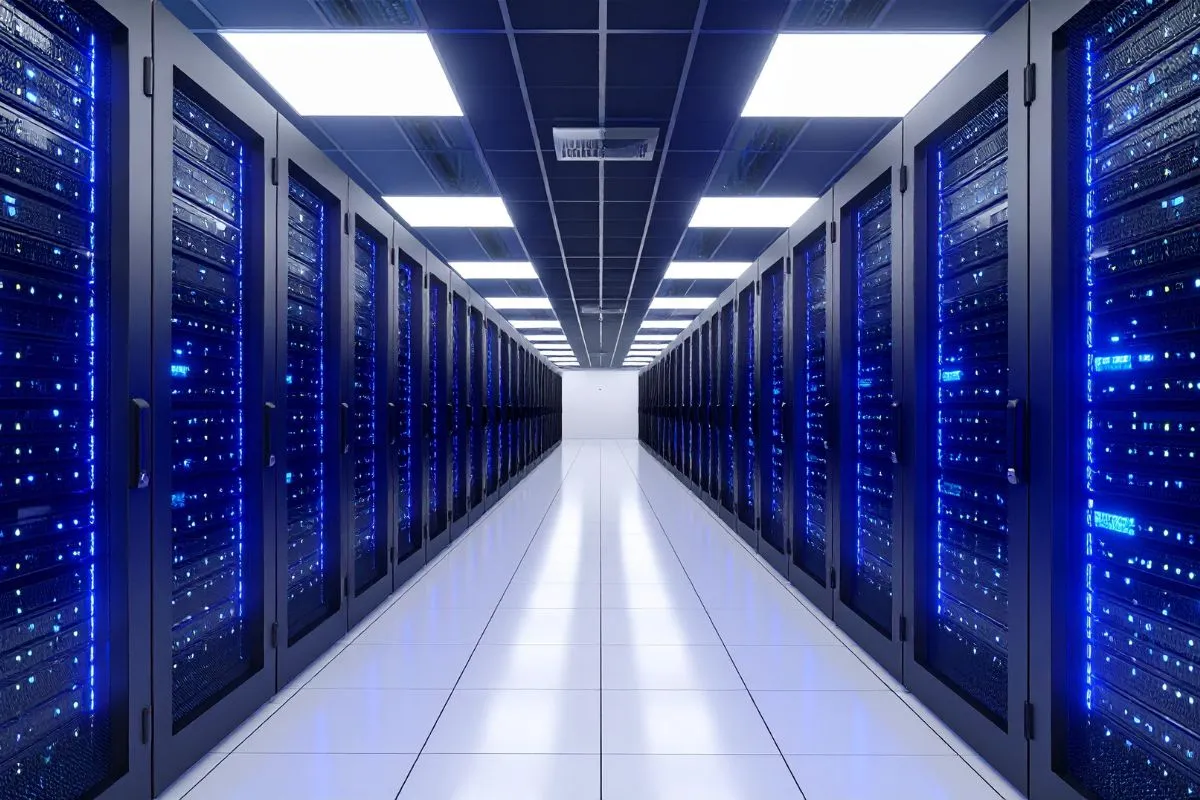
Every conversation with a large language model, every image generated from a text prompt, every fraud detection decision made in a payment authorization, every warehouse robot path planned in real time: all of it runs on physical infrastructure. The compute substrate of the AI economy is a specific class of server hardware built around specialized processors, high-bandwidth memory, and interconnect architectures designed for the mathematics of neural network inference and training. Understanding this infrastructure is not a specialist concern for hardware engineers. It is a strategic variable that determines which AI capabilities are economically feasible, which organizations can access frontier AI, and how the competitive dynamics of the AI industry will evolve over the next five years.
The GPU server as the default AI compute unit
NVIDIA’s dominance in AI compute infrastructure is the most significant structural fact in the current AI landscape. The H100 and H200 GPU families are the standard training hardware for frontier AI models, and the platform effects that NVIDIA has built through its CUDA software ecosystem over two decades have produced a competitive moat that AMD’s MI300 series and Intel’s Gaudi processors are competing against without yet displacing at scale.
The H100 SXM configuration, the datacenter variant used for AI training and large inference deployments, costs approximately $30,000 to $40,000 per unit. A training cluster for a large frontier model requires thousands of these units operating in coordination, connected by NVIDIA’s NVLink and NVSwitch interconnect fabric that enables the high-bandwidth communication between GPUs that large-scale parallel training requires. The capital cost of a frontier model training run is dominated by this hardware, and the compute cost of large-scale inference operations is similarly GPU-dominated for most production AI deployments.
The H200, which arrived in 2024, brought a significant memory bandwidth improvement over the H100 through the adoption of HBM3e memory, reducing the memory bottleneck that had limited inference throughput for large models with long context windows. For the specific workload of running large language models at production inference scale, the H200’s memory architecture improvement translates directly into higher throughput per unit of hardware cost, and the organizations that upgraded to H200 infrastructure experienced measurable improvements in the economics of their inference operations.
The competitive challenge: AMD, Intel, and new entrants
NVIDIA’s market position is being contested from multiple directions, and while displacement of NVIDIA’s dominance in the near term is unlikely, the competitive pressure is producing meaningful changes in the infrastructure options available to AI operators.
AMD’s MI300X has achieved enough production deployment traction to constitute a genuine alternative for inference workloads. Microsoft Azure, Meta, and Oracle have deployed MI300X infrastructure at scale, and AMD has invested in its ROCm software ecosystem to reduce the software compatibility gap with CUDA that has been the primary barrier to adoption. The MI300X’s integrated CPU-GPU memory architecture provides memory capacity advantages for specific large-model inference workloads that the H100 architecture does not match.
The more structurally interesting competition is coming from custom silicon: AI accelerators designed for specific workload characteristics rather than the general-purpose GPU architecture that NVIDIA optimized for broad applicability. Google’s TPU v5 family, deployed at scale within Google’s own AI infrastructure, provides the best-documented case study of what custom AI silicon can deliver for specific workload profiles. Apple’s Neural Engine chips, optimized for on-device inference at power budgets that datacenter GPUs cannot approach, demonstrate the design freedom that custom silicon provides when the workload constraints are known in advance. Amazon’s Trainium 2 and Inferentia 2 chips, available through AWS, represent the cloud provider alternative to NVIDIA hardware for the specific workload types they are optimized for.
The custom silicon trend is examined in its edge deployment implications in our coverage of embedded AI and how devices are becoming smarter. The same architectural logic, designing silicon for a specific AI workload profile rather than general-purpose compute, applies at datacenter scale and at device scale with different trade-offs.
The hyperscaler infrastructure race
The capital investment trajectory in AI infrastructure among the major hyperscale cloud providers represents one of the largest and most rapid accumulations of specialized capital equipment in industrial history. Microsoft, Google, Amazon, and Meta have collectively committed to spending hundreds of billions of dollars on AI infrastructure through 2025 and beyond. Understanding what this investment actually buys and what it enables requires looking past the headline numbers to the specific infrastructure decisions they represent.
Microsoft’s investment, substantially committed to expanding its Azure AI infrastructure in partnership with OpenAI, is concentrated in GPU cluster deployment and the networking infrastructure required to make large clusters operate efficiently. The specific challenge of connecting thousands of GPUs with the bandwidth and latency required for large-scale model training is a networking problem as much as a compute problem, and the investment in InfiniBand and eventually custom networking fabrics represents a significant share of the infrastructure capital.
Google’s infrastructure investment reflects its architecturally distinctive approach: a much higher proportion of its AI compute runs on custom TPU hardware rather than NVIDIA GPUs, enabling Google to operate its AI infrastructure at economics that external NVIDIA customers cannot replicate. The TPU investment represents a years-long capability bet that is now producing cost advantages in Google’s own AI services and potentially in its cloud offerings as TPU capacity becomes available to Google Cloud customers.
Meta’s infrastructure investment has focused specifically on the compute requirements of its open-source AI research and the inference infrastructure for its consumer AI products at the scale of its user base. The Llama model family’s training and the AI features embedded in Facebook, Instagram, and WhatsApp operate on infrastructure that Meta has designed and built rather than purchasing from cloud providers.
The competitive dynamics of this hyperscaler infrastructure race connect to the enterprise AI landscape examined in our coverage of the cloud AI battle between tech giants and to the governance implications for organizations choosing between these providers, detailed in our analysis of AI governance news and the hidden risks companies ignore.
Power, cooling, and the physical constraints on AI scaling
The infrastructure conversation about AI servers has increasingly incorporated a dimension that the compute performance narrative can obscure: the physical resource requirements of large-scale AI infrastructure. A single H100 GPU has a thermal design power of 700 watts. A training cluster of ten thousand H100s requires seven megawatts of power for the GPUs alone, before accounting for cooling, networking, and supporting infrastructure. At the scale of the planned AI datacenter buildouts announced by major technology companies and their cloud provider partners, the aggregate power requirement is large enough to strain grid capacity in the regions where these facilities are being built.
The power and cooling constraint is not a distant future concern. Datacenter operators are encountering it now in the form of longer-than-expected grid connection timelines for new facilities, power procurement competition with other industrial users, and cooling infrastructure costs that are increasing as ambient temperature increases reduce the efficiency of air cooling approaches that were viable at lower power densities. The operational and economic implications of AI’s power requirements are becoming a strategic variable in infrastructure planning at a level of visibility that was not present two years ago.
Liquid cooling has become the standard approach for high-density AI server deployments, with direct liquid cooling of GPUs providing the thermal management that air cooling cannot deliver at H100 and H200 power densities. The adoption of liquid cooling infrastructure is both an enabler of higher-density deployment and a structural change in the datacenter design and operations skills required to run AI infrastructure effectively.
What the infrastructure layer means for enterprise AI strategy
The AI server infrastructure landscape described above is primarily the domain of hyperscalers, major cloud providers, and large AI research organizations. Its relevance to enterprise AI strategy is indirect but real, operating through three channels.
First, the capacity and cost of AI inference infrastructure at the hyperscaler level determines the pricing and availability of the AI API services that most enterprises use to access AI capabilities. When NVIDIA H200 availability is constrained, inference costs on major AI APIs increase, and enterprise AI deployment economics change correspondingly. The supply chain normalization that eased GPU availability constraints through 2024 and into 2025 has contributed to the inference cost reductions that have made AI automation economically viable for a broader range of enterprise use cases.
Second, the custom silicon trend at the infrastructure level is the foundation of the edge AI and embedded AI capabilities examined in our companion articles on edge AI and local data processing and embedded AI and intelligent devices. The design principles that produce efficient datacenter AI accelerators are being applied at lower power budgets to produce the inference capabilities that edge and device deployments require.
Third, the infrastructure investments being made now by hyperscalers will determine the AI capabilities available to enterprise customers over the next three to five years, because the models that can be trained on the infrastructure being built in 2025 will be the models available for enterprise deployment in 2027 and 2028. Understanding the infrastructure trajectory is therefore part of understanding the capability trajectory that enterprise AI strategies should anticipate.
AI server infrastructure is the physical foundation of the AI capability that every organization in every industry is building strategy around. The GPU supply dynamics, the custom silicon competition, the hyperscaler capital race, and the power and cooling constraints are the variables that determine what is possible, at what cost, for enterprise AI deployment. These are not topics that require deep technical expertise to engage with strategically. They require the same kind of supply chain awareness that any organization applies to the physical inputs that its operations depend on.
For how this infrastructure enables distributed and local AI processing, see edge AI: why processing data locally is a game changer and edge computing and AI: the future of real-time processing. For the cloud dimension of the infrastructure battle, read cloud AI: the battle between tech giants.
The question every enterprise AI architect should be tracking: The inference cost per query for the AI models your organization depends on has changed in the past twelve months. Do you know by how much, do you understand why, and have you updated your AI economics model accordingly?