
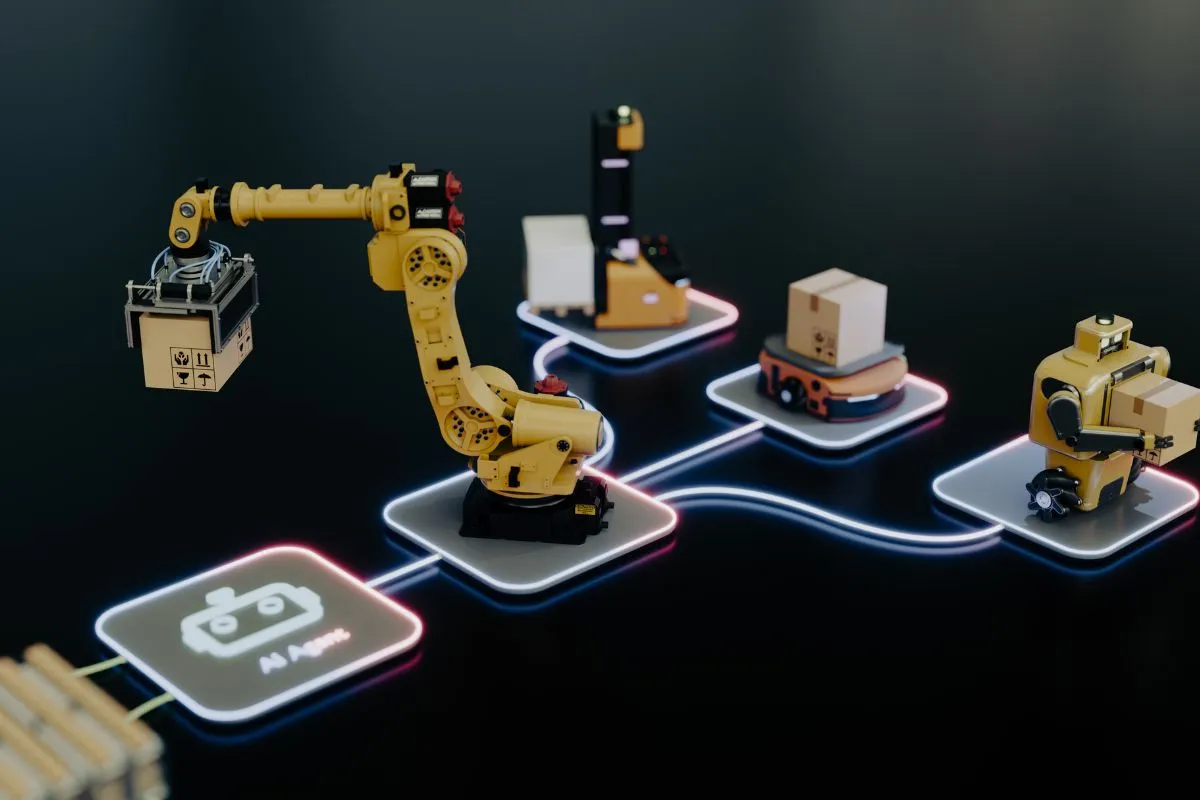
The smart factory concept has been in circulation since at least 2011, when Germany’s Industrie 4.0 initiative gave it institutional backing and a policy framework. Fourteen years of development have produced a significant gap between the vision and the reality: most manufacturing operations are not smart factories. They are conventional factories with islands of digital capability that have not been connected into the integrated operational intelligence that the concept requires. What AI is changing in 2025 is not the vision of the smart factory but the cost and complexity of building toward it, specifically the ability to extract intelligence from existing infrastructure without the wholesale replacement programs that earlier generations of smart factory technology required.
The intelligence layer that changes what existing infrastructure can do
Manufacturing AI’s most immediate and commercially significant deployment pattern does not involve new robots or new production equipment. It involves new software running on existing sensor networks, existing PLCs, and existing production infrastructure that has been generating data for years without the analytical layer to convert that data into operational decisions.
Predictive maintenance is the application where this pattern has generated the most documented ROI across the broadest range of manufacturing environments. The physics of mechanical failure produces detectable precursors: vibration signatures, temperature patterns, acoustic profiles, and power consumption anomalies that precede failure by hours or days in ways that statistical models trained on historical failure data can identify reliably. Siemens Industrial Edge, ABB Ability, and Rockwell Automation’s FactoryTalk Analytics have each deployed predictive maintenance capabilities on existing production equipment that their customers report reducing unplanned downtime by 20 to 40 percent in initial deployment periods.
The economic translation of downtime reduction depends on the production context, but in capital-intensive continuous process manufacturing, the cost of a single unplanned production stoppage frequently exceeds the annual cost of the predictive maintenance system that would have prevented it. The payback period calculation is correspondingly straightforward, which explains why predictive maintenance has become the entry point for AI adoption in manufacturing across industries from aerospace components to food processing.
Quality control: computer vision at production speed
Visual quality inspection has been the most labor-intensive and least scalable element of manufacturing quality assurance in industries that produce physical products at high volume. Human inspectors working at production line speeds face fatigue effects that degrade detection consistency across shifts. Camera-based inspection systems that preceded AI vision could detect only defect types for which they had been explicitly programmed, missing novel defect patterns and struggling with the variation in appearance that characterizes real production environments.
AI computer vision systems that learn to recognize defects from labeled examples, rather than requiring explicit programming for each defect type, have changed what automated inspection can cover. Landing AI’s LandingLens platform, Cognex’s ViDi deep learning vision software, and Keyence’s AI-based inspection systems have each been deployed in manufacturing environments where the defect variability or the detection speed required exceeded the capability of rule-based machine vision. The performance comparison data from these deployments consistently shows AI vision systems matching or exceeding human inspector accuracy at line speeds that human inspection cannot achieve.
The computer vision capabilities underpinning these quality systems are examined at the foundational level in our coverage of the computer vision breakthroughs changing AI’s visual capabilities. The manufacturing quality control application represents one of the most commercially mature deployments of those capabilities, operating in production environments with the reliability that industrial applications require.
Process optimization: closing the loop between sensing and control
Beyond predictive maintenance and quality inspection, AI is beginning to operate at the core of production processes: adjusting process parameters in real time based on sensor data to optimize yield, energy consumption, and product quality simultaneously. This is the application with the highest value and the highest implementation complexity, because it requires AI to operate not in an advisory role but in a control role, making or recommending process adjustments that directly affect production outcomes.
Chemical and pharmaceutical manufacturing have been the early deployment contexts for AI process optimization because these industries already operate with extensive sensor networks and sophisticated process control systems that provide the data infrastructure AI optimization requires. BASF’s deployment of AI process optimization in chemical production and several pharmaceutical manufacturers’ use of AI for bioprocess control have produced documented yield improvements that represent significant cost savings at the production volumes these organizations operate.
The control loop architecture for AI process optimization requires specific governance design that distinguishes it from other manufacturing AI applications. An AI advisory system that suggests process adjustments to human operators who implement them is substantially different in its governance requirements from an AI control system that adjusts process parameters autonomously. The permission architecture, override capabilities, and monitoring requirements differ correspondingly, following the same principles that govern agentic AI in any operational context, examined in our coverage of AI agents and the governance architecture that autonomous systems require.
Robotics and collaborative automation
Industrial robotics has been part of manufacturing automation for decades, but the AI integration currently underway in robotics represents a qualitative change in what robots can do rather than an incremental improvement in speed or precision. The specific change is flexibility: traditional industrial robots perform precisely defined, repetitive tasks with high reliability but require extensive reprogramming and reconfiguration when tasks change. AI-enabled robots that can perceive their environment, plan motion sequences in response to variability, and learn new tasks from demonstration rather than explicit programming are beginning to change the economics of automation for the lower-volume, higher-mix production environments where traditional robotics has been impractical.
Universal Robots and Fanuc’s collaborative robot lines, combined with AI perception and planning capabilities from companies including Covariant and Plus One Robotics, have produced deployments in warehouse sortation, order picking, and assembly tasks where the throughput and flexibility requirements previously exceeded what automation could economically deliver. The productivity implications for e-commerce fulfillment, where order mix variability has historically resisted automation, are significant enough that Amazon’s continued investment in AI-enabled robotics technology represents a structural competitive advantage over logistics operators that have not made comparable investments.
The data foundation that manufacturing AI requires
The manufacturing AI applications described above share a common prerequisite that is frequently underestimated in technology adoption narratives: they require data that is clean, connected, and contextually labeled at a quality level that most manufacturing operations’ current data infrastructure does not provide. Predictive maintenance AI requires sensor data with accurate timestamps and reliable labels identifying which sensor readings preceded which failure events. Quality inspection AI requires labeled images identifying defect types at the granularity the model needs to learn from. Process optimization AI requires process parameter data connected to quality and yield outcomes with enough temporal resolution to identify causal relationships.
Building this data foundation is the implementation work that determines whether manufacturing AI delivers its promised value or produces models too noisy to deploy confidently. The organizations that have generated the strongest manufacturing AI outcomes are those that invested in data infrastructure before AI models, treating the sensor network, the data historian, and the labeling workflow as the foundational investment that AI capabilities build on. This is the manufacturing-specific expression of the data governance principles examined in our analysis of why AI data is becoming a governance crisis for enterprises.
Manufacturing AI in 2025 is generating documented operational value in specific applications, with predictive maintenance, AI quality inspection, and process optimization representing the most mature deployment categories. The smart factory vision that has been described since 2011 is being built incrementally rather than through wholesale transformation, with AI capabilities layered onto existing infrastructure rather than requiring it to be replaced. This is a more practical path than the vision implied, and it is producing real results in the operations that have pursued it with the data foundation discipline it requires.
For the edge computing infrastructure that enables manufacturing AI at the equipment level, see edge AI: why processing data locally is a game changer and edge computing and AI: the future of real-time processing. For the embedded AI capabilities that make smart devices autonomous, read embedded AI: how devices are becoming smarter.
The question every manufacturing operations leader should answer before the next capital planning cycle: Which of your production lines have the sensor data infrastructure that manufacturing AI requires, and for those that do not, is the infrastructure gap a technology problem or a data governance decision that has not yet been made?