

December 2025 ended the year on two fronts at once. While the frontier model sprint that defined November spilled into the month OpenAI shipping GPT-5.2 under the pressure of an internal “code red” the bigger structural story came from Amazon. At AWS re:Invent, the conversation moved past which model is smartest and toward who can run agents autonomously, on custom silicon, inside an enterprise’s own walls. The unit of progress shifted again: from a model that answers, to an agent that acts, to an agent that works unattended for days. Here is the latest AI news of December 2025, dated and sourced, and what the year’s final month meant for the teams that have to operate all of it.
| Area | What shifted in December 2025 | Why it mattered |
|---|---|---|
| Models | OpenAI shipped GPT-5.2 under a “code red” | November’s frontier sprint spilled into December |
| Infrastructure | AWS unveiled Trainium3, Graviton5 and AI Factories | The custom-silicon and sovereign-AI race widened |
| Agents | Frontier agents ran autonomously for hours and days | Agent autonomy stretched from minutes to days |
| Open weights | Mistral Large 3 launched, open-weight, first on Bedrock | Europe kept a credible open, sovereign option in play |
| Year coda | The race split into two fronts: models and infrastructure | Winning shifted from best model to best operating layer |
Models: GPT-5.2 closes the frontier sprint
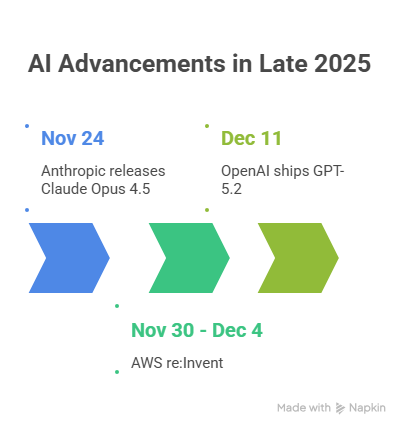
On December 11, OpenAI released GPT-5.2, pulling the launch forward from a planned late-December window. The reason was competitive, not technical: after Google’s Gemini 3 took the benchmark lead in November, Sam Altman reportedly issued an internal “code red,” redirecting engineering effort back to core model quality. GPT-5.2 arrived in three modes Instant for everyday work, Thinking with standard and extended reasoning, and a heavier Pro tier and tied into Microsoft’s Work IQ for context across a user’s documents and tools.
The model itself mattered less than what its timing revealed. A flagship lab accelerating a release by weeks because a rival shipped first is the clearest possible sign that the frontier is now a genuine race rather than a procession. The lead that changed hands three times in November did not settle in December; it stayed contested, which is exactly why any decision to standardise on one model still carried the short shelf life that the november releases exposed.
Infrastructure: AWS struck back with silicon and sovereignty
The month’s centre of gravity was AWS re:Invent, held November 30 to December 4, where Amazon made its case that it is a serious AI infrastructure player and not just a place to rent other companies’ models. It unveiled Graviton5, its most powerful custom CPU, and Trainium3 UltraServers packing 144 chips for roughly 4.4 times the performance of the prior generation, with Trainium4 promised for 2026. It expanded the Amazon Nova model family Nova Pro, the multimodal Nova Omni, the speech model Nova Sonic to a one-million-token context window.
The most strategically interesting launch was AWS AI Factories: dedicated AWS infrastructure, combining NVIDIA GPUs and Trainium chips, deployed inside a customer’s own data centre. It is a direct answer to the sovereignty problem letting regulated organisations and governments run frontier AI on hardware they physically control while meeting data-residency rules. Read alongside October’s custom-silicon arms race, December made the pattern undeniable: the competition has moved down the stack to chips, power, and where the compute physically sits.
Agents: autonomy stretched from minutes to days
For most of 2025, an AI agent meant something that ran a task for a few minutes and handed back to a human. December moved the goalposts. AWS introduced a set of frontier agents a virtual developer called Kiro, a security agent that runs code reviews and penetration tests, and a DevOps agent that one bank used to resolve incidents in fifteen minutes instead of hours built to work autonomously for hours or days at a stretch. It paired them with Nova Act, a browser-automation agent reported at around 90% reliability, and Bedrock AgentCore, a production platform with memory, browser tooling, and observability that supports any agent framework.
The leap from minutes to days is not a quality upgrade; it is a category change. An agent that works overnight without supervision needs a different kind of trust than one a human watches in real time durable permissions, audit trails, rollback paths, and a clear boundary around what it may touch. December handed enterprises agents capable of unattended work and, with it, the unglamorous governance burden of deciding where unattended work is actually safe.
Open weights: Mistral Large 3 keeps Europe in the game
Amid the American giants, Mistral used re:Invent to launch Mistral Large 3, its most advanced open-weight model, optimised for long context and multimodal reliability and available first on Amazon Bedrock. The release matters as a counterweight: it keeps a credible open, European option on the table for organisations that need to inspect, host, or fine-tune a frontier-class model rather than rent it behind a closed API. In a month dominated by closed flagships and proprietary silicon, the open-weight lane stayed open the same sovereignty logic running through the new models reshaping AI.
What December and 2025 left for the teams building on AI
Step back from the month and the shape of the whole year comes into focus. May was the agentic turn, when models learned to act. October was the buildout, when AI started pouring concrete and buying chips. November was the sprint, when the frontier lead became a moving target. December tied them together: the race is now fought on two fronts at once the model that reasons and the infrastructure and agents that put it to work and the second front is where most enterprise value, and most enterprise risk, now lives.
The reorientation December demanded closes the loop on the year. Choosing a model is a decision that expires in weeks; building the layer that runs models routing between them, governing autonomous agents, and deciding where compute physically sits is a decision that compounds. The organisations that spent 2025 chasing the best model entered 2026 having optimised the part that keeps changing. The ones that built the operating layer around interchangeable models and governed autonomy built something that holds.
Frequently asked questions
What was the biggest AI news in December 2025? Two stories shared the month: AWS re:Invent (November 30 to December 4), where Amazon unveiled Trainium3 silicon, AI Factories, and autonomous frontier agents, and OpenAI’s December 11 release of GPT-5.2, accelerated under an internal “code red” prompted by Google’s Gemini 3.
Why did OpenAI release GPT-5.2 in December? After Gemini 3 took the benchmark lead in November, OpenAI reportedly declared a “code red” and pulled GPT-5.2 forward from a planned late-December window. It launched on December 11 in Instant, Thinking, and Pro modes.
What did AWS announce at re:Invent 2025? AWS introduced Graviton5 CPUs, Trainium3 UltraServers, the Amazon Nova 2 model family with one-million-token context, Bedrock AgentCore, Nova Act for browser automation, autonomous frontier agents, and AI Factories for running AI on infrastructure inside a customer’s own data centre.
What is the AI news today around agents? December marked the shift to long-running autonomy. AWS frontier agents like Kiro were built to work unattended for hours or days, a category change from the minutes-long task agents that defined most of 2025 and one that raises new governance and oversight requirements.
What was the main lesson from AI in 2025? That the durable advantage is not the model but the layer around it. With the frontier lead and pricing moving monthly, the teams that built routing, agent governance, and infrastructure choices fared better than those that standardised on a single model.
December closed a year in which AI stopped being a product you choose and became a system you operate. The frontier kept moving, the chips went custom, and the agents learned to work while you sleep which means the hardest questions are no longer about capability but about control. So as the calendar turns, the question for anyone running an AI roadmap is the one 2025 spent twelve months sharpening: not which model you picked, but whether you built the operating layer to govern agents you can no longer watch in real time. Did you build the system, or just buy the model?